May our heart’s garden of awakening bloom with hundreds of flowers – Thich Nhat Hanh
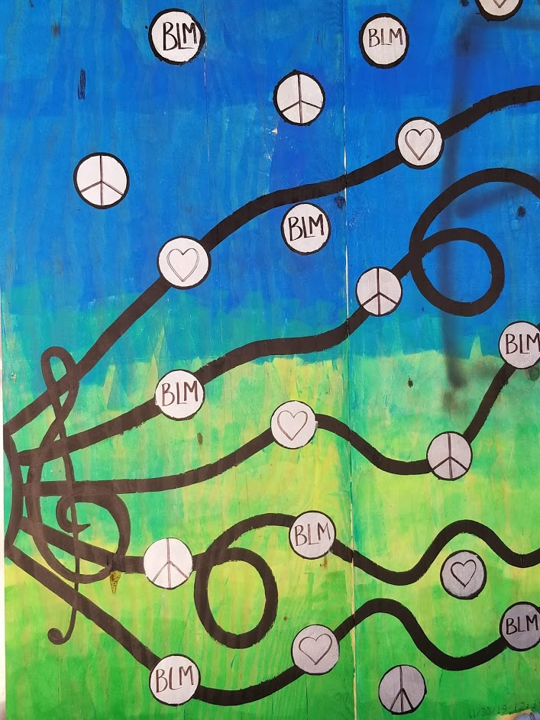
It is hard to embrace this moment as a time of awakening and blooming when we are surrounded by so much suffering. Outdoors, I am spending most of my time in the backyard, enjoying the surrounding gardens. This is the perfect place to be reminded exactly how growth works.
Before everything in the garden is in bloom, it is stark and gloomy. The death that preceded it nourishes a new beginning. There is not much to see above, but underneath is teeming with life; preparing to emerge as something beautiful to the observer. When we see it, we remember everything has it’s place in a cycle of life.
We do need to tend to the gardens of our cultivation. We cultivate our home and garden for the purpose of helping us live well. Our heart’s instinct to grow and love must be similarly cultivated in order to flourish in our modern world. Just as too many are deprived of livable environments, too many are deprived of the knowledge that they are both lovable and loving. What can emerge as something beautiful is deprived of what it needs to survive. If we see the whole of life as our garden, we must tend to this problem.
If we have been paying attention, we have been shaken by this pandemic. We are becoming aware of the depth of our connection to one another at the same time. We are waking to the fact that there is far more below the surface than we may have once thought. No one is immune to this disease, just as no one was ever immune to the multitude of problems we were once quick to ascribe to others. In short, our collective consciousness is teeming with life.
Will we approach this gloomy, soiled and wormy mess with terror? Or, will we give it the sunshine, air and water it needs to emerge as something beautiful? Our incredible, fragile, pounding, broken and irreplaceable hearts must now decide. For some, it is a greater act of faith than it will be for others. It may surprise us just who has to leap the furthest.
But I suppose the most revolutionary act one can engage in is… to tell the truth – Howard Zinn
I will add that among those, I believe the most courageous is to speak truth to power. I know many good people, but I have met only a few people in my lifetime who have been willing to do so.
Why is it that the possession of power causes one to stray so far from what is true? I think it is because we confuse ‘having power’ with exercising ‘power over.’ We are empowered just as we are ‘endowed by our Creator’ with unalienable rights, but I do not believe we are meant to exercise power over others. That is, we do not need another person to submit to us in order for something mutually beneficial to happen. We only need such force when our desires come at the expense of another person’s life, liberty or their pursuit of happiness.
And that seems to be the catch, isn’t it. Mutual benefit can be difficult to conceive in a culture that insists on having ‘winners’ and ‘losers;’ when winning is predicated on the demonstration of, or the ability to demonstrate, power over others. When that is the case and power is not earned by consent, all means to maintain power somehow become legitimate in the eyes of the beholder – the truth of its illegitimacy be damned. Those who wish to achieve ‘success’ in such a paradigm are expected to oblige this as the only acceptable truth.
Hierarchies do not have to be plagued with corruption and abuse in order to survive. If people accept the wisdom of their leaders as beneficial to them, they can freely chose their leaders without being forced to submit to them. Wise leaders are reluctant to exercise power over others. They do not need to do so in order to remain in power. What they need to do is accept that a true ascent to leadership is often an exceedingly slow and arduous process by which the greatest sacrifices to be made will be their own.
Until we are more successful at choosing leaders (and we ourselves stop measuring success by the extent to which someone abuses their power), truth-tellers will remain an endangered species. When no one feels safe to speak the truth to power anymore, then we know power is being abused. The truth of such abuse will always be most visible in the pain and suffering of marginalized and oppressed people.
Enough suffering can coalesce into movements that illuminate the illegitimacy of power. As that is happening today, will we lift those voices and let that truth emerge? Will those who have not yet been made to suffer be willing to listen before it’s too late?
How much of design is about staging? I would argue all of design is staging. It’s hard not to concede the truth of Shakespeare’s observation that ‘all the world’s a stage.’ When we design, we’re simply setting the stage for what is going to take place within the parameters of our design. Even without the presence of actors to breathe life and meaning into a design – our perception of design is intertwined with our imagination of what could take place within. Design is a process of engaging the potential of a space to elicit purpose – be it noble and aspirational or something else.
Perhaps acting on this principle is the most obvious link between my career as an educator and as a designer. My entire career in education was dedicated to engaging individual potential; understanding and studying how factors such as the quality of spaces and individual interactions in those spaces played a key role. Of course in that context, the designated purpose was primarily to learn. The goal was for learning to take place in ways that were aligned with the mission and values of an institution.
What does the design of our spaces facilitate in terms of our ability to act with purpose and in alignment with our values? What does it communicate to the observer about the role of the aesthetic in our lives? Is it the goal of a design to generate an appreciation of something beautiful and/or is the presence of beauty that inspires something more purposeful to take place?
I argue that without purpose there is no such thing as beauty and without beauty, it is impossible to find purpose. Absent this connection, we can find things attractive and we can do things but within ourselves we do not experience the world the same way. Our three-dimensional world gets flattened into two dimensions; and with insufficient meaning. We are not inspired by things that look nice or by the act of purchasing things; except to perhaps purchase more nice things. We are inspired by what an appealing space welcomes us to do with our time; purchases are inspiring if they are in furtherance of another goal or objective.
Even if our clients don’t readily see the depth of connection between beauty and purpose (just as the students with whom I worked for many years often did not either), it is imperative for designers to understand this connection. It is the failure to consistently observe this connection or speak to this connection in our work that can sometimes paint interior designers as being vapid or only concerned with what is attractive, or worse yet simply trying to make a sale.
Once we connect purpose and beauty together, our definition of both beauty and purpose becomes so expansive it can encompass a whole world of human experience. The value of designers is demonstrated in creating spaces that fully integrate what individuals, organizations and cultures define as aesthetically beautiful as it relates to their purpose. The more designers can do that sans judgment, challenging ourselves to see beauty and purpose combined in all of its forms, the greater potential for us to be fully purposeful ourselves.
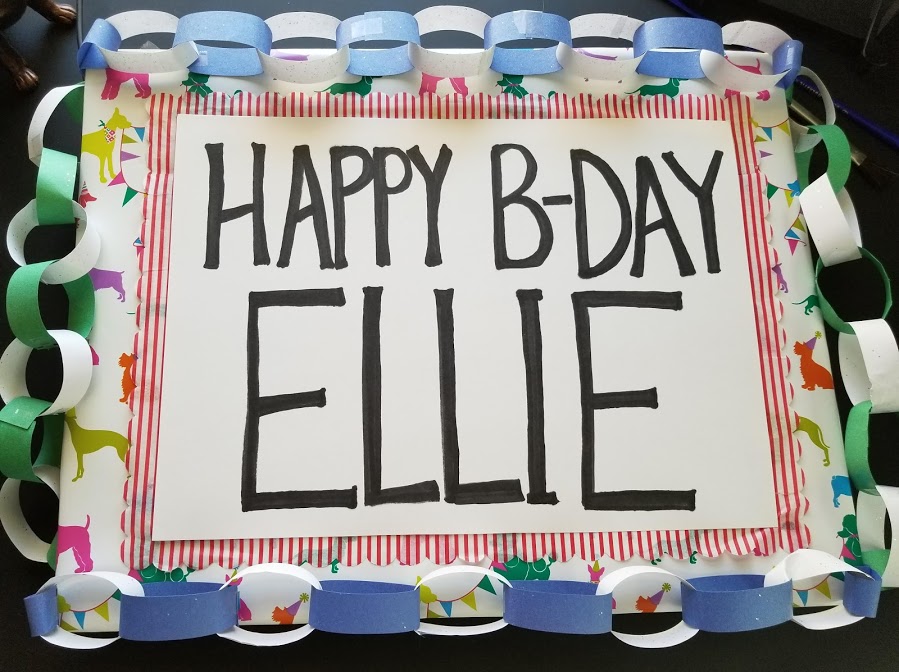
Even in the wake of a global pandemic, there is no shortage of life events and important milestones worth celebrating. I recently challenged myself to get crafty in preparation for the birthday parades of two young friends who enjoy making and sharing crafts. I pushed myself to use what I already had around the house rather than taking advantage of the usual conveniences. The extra time and effort seemed only appropriate and far more thoughtful.
There’s something particularly satisfying in being inventive during this time. When it’s so tempting to get caught up in what we don’t have, it’s great to be reminded there’s often a way to make something special out of what feels like nothing much. Seeing happy young faces light up while experiencing a whole new kind of celebration was inspiring.
Sometimes we get so attached to the idea of how something is supposed to go, we forget completely that making meaning is something each of us does uniquely and individually. The consequences of our current circumstances teach an invaluable lesson. As many are learning, we can make meaning and experience profound joy in any number of ways.
When we stop worrying about what others find meaningful and focus on our own meaning in design, there can be fewer limits to our imagination. That does not have to translate into expense or excess either. Pursuing our own meaning and sharing our joy with others allows all of us to teach one another new ways to experience joy. Sometimes less is in fact, far far more.
The right designer does not substitute their meaning for yours in helping you realize your project goals. Our job is to understand the design process involved with making meaning; and then put it to work for our clients. The point of our involvement is to make sure that process doesn’t deprive you of any meaning or joy by the time your project is complete.
Working in collaboration with one another, sometimes an entirely new source of inspiration and meaning can emerge from the process. In any case, a great designer will be your partner in the journey toward something that holds deep meaning for you; making it possible for others to share it with you in the way you intended. That is my purpose in working with every client.
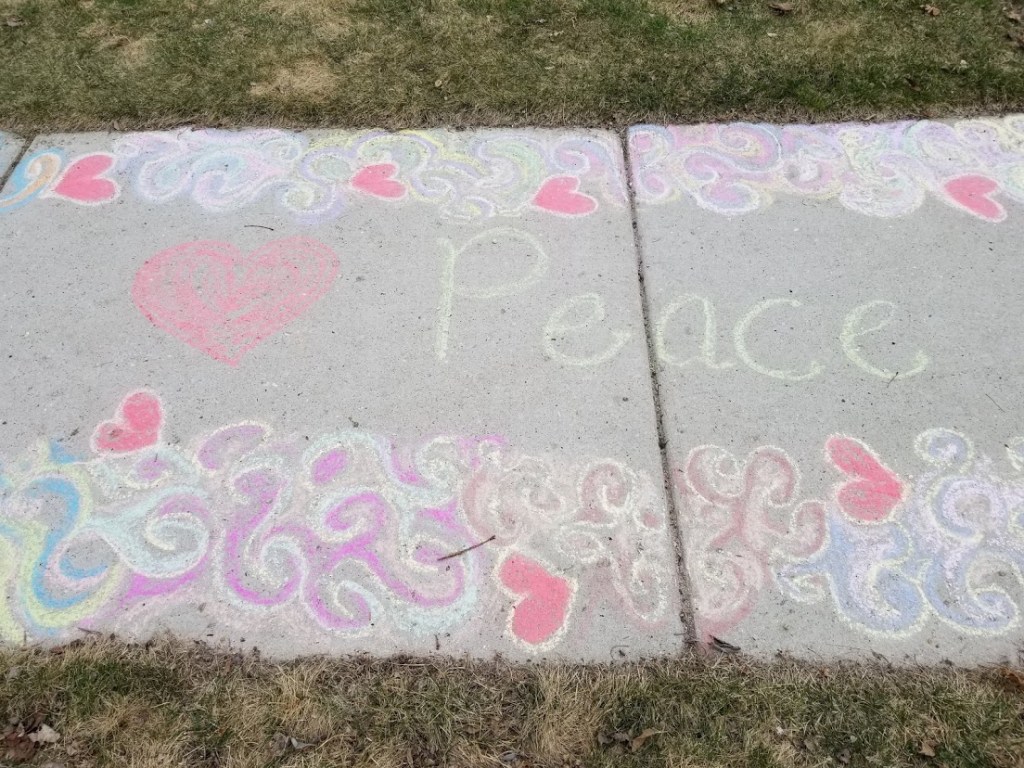
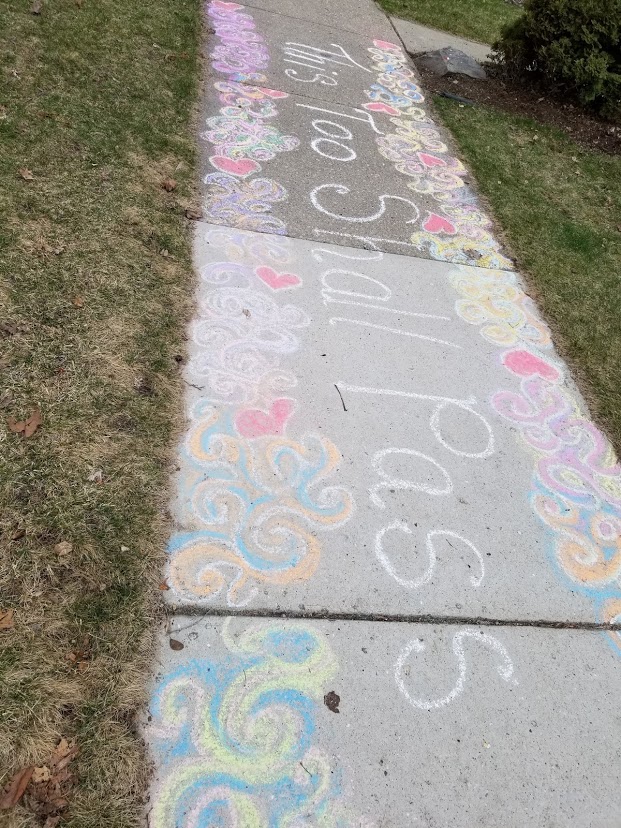
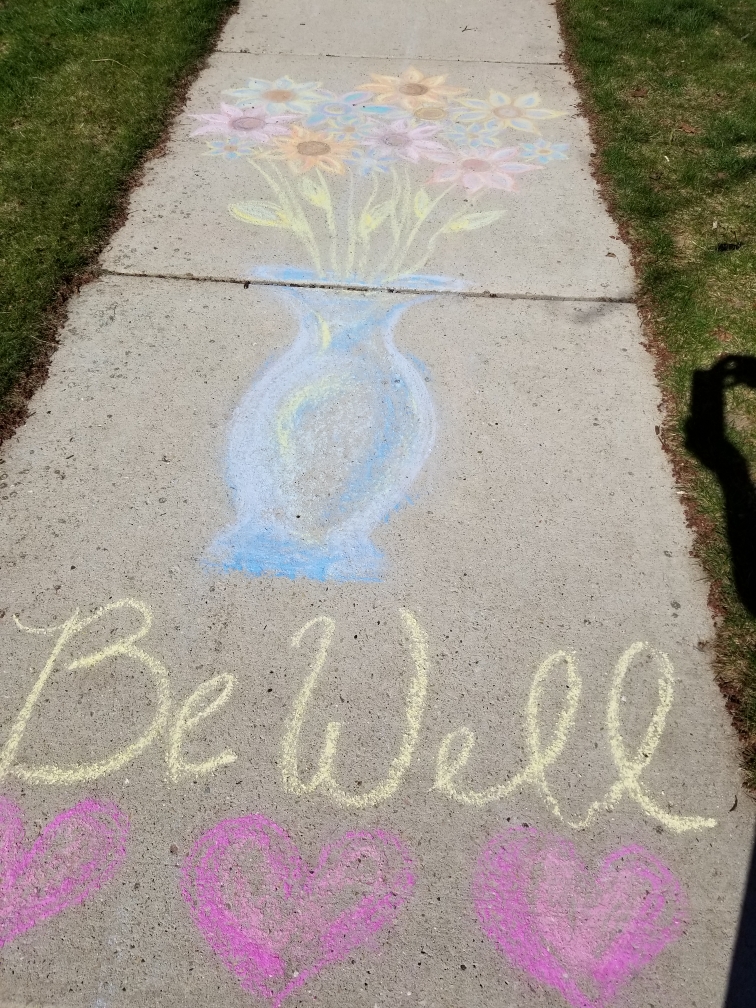
These past weeks, I have adopted staying home, keeping my distance and disinfecting as primary strategies for maintaining my physical health. Both physical and mental health are critically important to maintain during this very challenging time. For mental health, I have been incorporating creative ways to express support and gratitude.
Something I’ve come to appreciate is that wellness always starts at home. Wellness is also very important at work, but it is not the same for several reasons. For one, few of us have sufficient control in the workplace to ensure it provides for our individual wellness needs. Second, our wellness beliefs and behaviors are typically shaped long before we ever take our first job; by early life experiences taking place within the home. Generally speaking, most learn that home life is supposed to be the antidote to whatever toxicity we should expect to experience at work. Whether it actually is, or not is a separate matter.
Support and gratitude play an important role in our lives at home and work. At work, we too often waste inordinate amounts of energy in the pursuit of support and gratitude from others for what we do. In many cases we pursue it for good reasons; chief among them being that without it, we rarely advance in any meaningful way. No advancement equals no new pay, no new challenges and fewer accomplishments. Support and gratitude are therefore commonly withheld in the belief that doing so can control the outputs of others to one’s advantage. The unhealthy culture of work diminishes support and gratitude into forms of currency for transaction; offered only exchange for something of value to us.
The coexistence of a transaction mindset along with imbalances in power have a profound impact on our lives. Most deeply, it impacts our motivation and the development of our work products. This is true of our work products both personally and professionally. The impact is not positive. Some of us have learned about transactions from an early age; utilized at home in order to get needs met by distant parents. In some cases that mindset simply continues into our work life to our ongoing detriment. We view life generally as a set of transactions with otherwise disinterested parties, offering little of ourselves without a positive assurance of ‘what’s in it for me.’
What a transformation it can be to freely offer gratitude and support without expectation; knowing that it is abundant within us to give. What many of us are discovering during this extended period staying at home, is how well we really are. In learning to survive in the world of transactions, has our home life preserved our ability to use our abundant internal resources in order to thrive? Are we still strong enough to use these resources to the benefit of ourselves and others?
During a pandemic we can’t offer support and gratitude in direct exchange for our health, our paycheck, or our next meal. Nonetheless, the powerful displays of support and gratitude from people’s homes throughout the world are lifting spirits beyond our circumstances. That spirit has inspired countless acts of generosity that help those in greatest need. Being in a position to know or discover these resources within us is liberating. Doing so in tandem with self-sacrifice can even be enlightening.
Is the world of transaction, represented as ‘the economy’ so important to some because it’s what puts food on their table or is it because it is the only way some know how to operate in this world? In some cases the former is true, but in some cases the latter (or both) is true. Such scarcity forges some unique and tragic alliances during these times. Nonetheless, I believe the power of our collective abundance of spirit will lift us through these times together. With that, I remain grateful and hopeful for our future.
It’s a difficult time for everyone, facing a global pandemic and all of the consequences associated with tough measures to keep people safe. I don’t expect many, if any at all, to be thinking about a redesign of their space. Clearly, no one should be planning large events in the coming months. So, my business is necessarily flattening out and I’m using the opportunity to do my part by staying home.
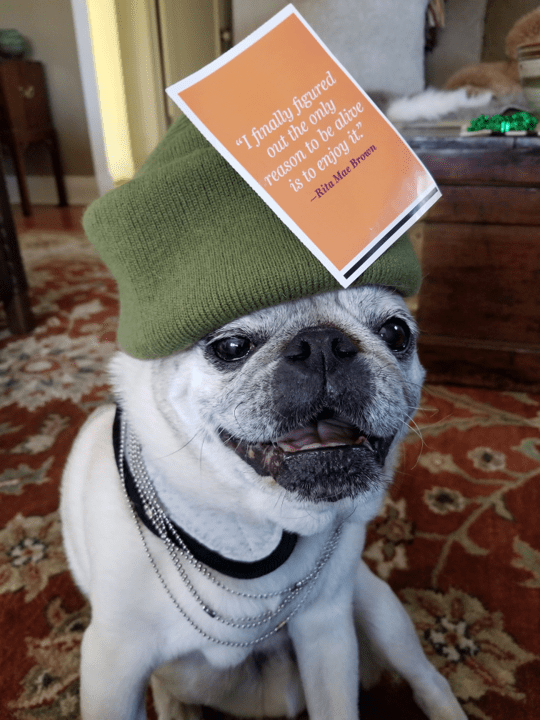
I have one happy pug right now, along with our standard poodle and two cats enjoying the company. My little Stanley though, he just celebrated his 15th birthday with a big grin amidst all of this chaos. He has severe arthritis, occasional incontinence and general difficulty moving. He has to be carried part of the way to most places. Most of his day is spent napping. But still, pick him up to go to the back yard, bring him in and put a bowl of food in front of him; and then treat him to a little dress up time with a photo shoot – and that guy just beams. He is a good mentor for me during this time.
If we’re doing our part, our lives will get pretty stark and simple in many regards right now. What I’m learning is that if we can see through the chaos and embrace the simplicity; there exists the possibility that we will experience incredible little moments of joy. These are little moments we’re often too busy, or too distracted, to observe and metabolize on a spiritual level. Slowing down and extending kindness, being creative and silly, sharing it with others, laughing and loving together – those ingredients make up the antidote to my funk. That, and one funky little pug. Thanks buddy!
Take care everyone, I’ll try to put this little happy out into the ether….hope it gets to you. Be well.
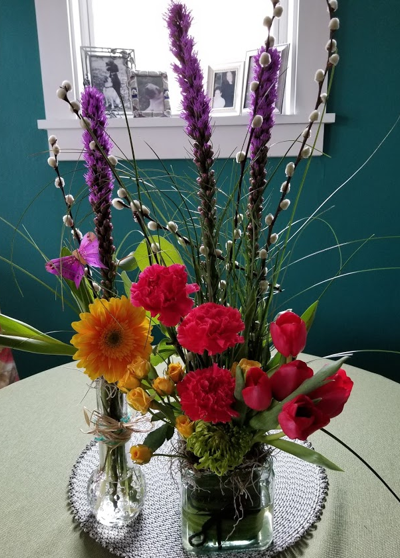
Ahhhh, spring is coming and what a great way to anticipate its arrival; developing my floral arranging skills. For me, few things can top the added splendor of fresh cut flowers in the house. It’s instant decadence when introduced to most any space. And though it may seem an unnecessary splurge to some, I argue there are not many design elements that can make a similar impact at the price point of fresh flowers. That’s even more true when you have the space to grow your own.
Granted, floral arrangements are only temporary features and have to be replaced. But, you can combine them with a muted or neutral palette and still completely transform your space in any number of ways depending on the blooms. That’s far more simple than changing paint or wallpaper. I personally feel much better adding and replacing flowers when I know I can turn the old ones over into the garden and help new plants to grow. What other aspects of your interior design are so eco-friendly?
Irish on my mother’s side, I’ve always enjoyed a fun St. Patrick’s Day celebration. And lucky me, it turned out to be my best pug buddy Stanley’s birthday. For nearly every year of is life, we celebrated together at the St. Patrick’s Parade in Madison. He always loved the opportunity to show off his St. Patrick’s Day attire. This year is number 15 for him and unfortunately he’s not up to the crowds this year. So, to keep his birthday at home special, I ordered these custom sweatshirts. It will be a special reminder to me to appreciate the gift of his wonderful little life this year especially; giving me so much love for as long as I could be a part of it. We should appreciate all of the love that surrounds us and it never hurts to accompany that appreciation with a fine pint of your favorite ale on St. Patrick’s Day!
Factors such as contstruction and durability matter most when you’re thinking about them the least.
My household was hit hard by the flu season this year, despite flu shots and appropriate precautions to prevent exposure. It’s awful…please take care out there.
Growing up in a home with four siblings and a nurse mother, I have developed a rather strange appreciation for the smell of bleach and most any other household disinfectants. I have been using it liberally to disinfect my own house after many days spent sequestered with the flu. I could compare the smell to what I imagine a TB ward would have smelled like (it does). Instead, I first think of my mom’s strenuous efforts at home to prevent us from catching anything that would have landed on her throughout a day spent at work in pediatrics helping all manner of sick kids. Smells like home to me, oddly enough!
Quality of construction and durability are things we shouldn’t take for granted when purchasing furniture, rugs, carpet and other items we use everyday. What I describe above is just one particularly gross case in point for why we need to take those things into account. Of course, quality of construction is important when it comes to staying comfortable while you’re passed out on the sofa for days on end; so is durability of your fabrics. What happens when it comes time to clean? Or do you do it? Please tell me you do…will your fabrics stain when exposed to that can of spray disinfectant or will the seams pull apart when you have to vacuum or scrub off some of your abuse?
Some people have a perception that money spent on designer products is primarily for the purpose of obtaining status as someone who can afford those products. In the presence of less expensive copies of popular designer looks, it’s easy to see why someone might think that is the case. In rare cases, that may be correct. However I find that in the vast majority of cases the consumer correctly assumes they are prioritizing quality of construction and durability when they invest in designer products. When products are associated with a name or brand, there is considerably more pressure to present consumers with something that will perform over time, lest that name or brand sacrifice future buyers who have already chosen to invest in their product over less-expensive options. Savvy consumers know compromising performance presents a gamble most established brands cannot take. I have seen some legacy brands fold however for having learned that lesson too late.
Another misconception that exists involves the belief that designer products are categorically more delicate and high-maintenance compared to other products. Actually, the opposite is most likely true. If it’s not true; it’s often obvious that a product is being prized for a separate reason (for example, no one really expects a gorgeous embroidered silk to be exceptionally durable though it’s expected be quite expensive for being extremely labor intensive and also rare). Materials and construction drive the overall cost of products. Detailed application of knowledge in those areas will extend the life of the product and consistently command higher prices for a good reason.
We have come to appreciate those details that drive cost such as durable fibers, solid wood, expert joinery and attentive seaming. We have learned to appreciate those details precisely because they have maintained our furnishings and kept them beautiful for generations. These are past generations that had to survive far more deadly epidemics; often caring for their sick at home. Their furnishings couldn’t disintegrate as many would today; de-laminating or featuring faux wood paper that would bubble off when the basin set was placed upon them. They didn’t have the privilege (or wasteful tendency) of tossing and replacing items that wouldn’t hold up to the demands of a typical household.
On the commercial side of things, it’s even easier to see why quality of construction and durability are of paramount importance. Healthcare is a prime example; we can multiply our household concerns hundreds of times over when considering those environments. Those considerations and the performance of commercial products often drives the cost of those products beyond the reach of individual consumers; it’s easy to see why when you consider the demands of those environments.
So, while my illness is thankfully no longer communicable, I hope my strategy as a designer remains highly communicable throughout the years. As your designer, I will invite discussion about how to manage multiple priorities within your design including budget. I will continue to advocate for the best possible investment of resources into your design but you will always define the parameters of your design. My goal will simply be to consistently and honestly communicate the implications of those decisions that are required of you in achieving the best possible design within those parameters. The result will be an enduring tribute to what I hope will be your long, happy and healthy life.
I am currently working with The Psychology Clinic, Inc. to plan their celebration of 30 and 10 years in Madison, Sauk Prairie and Baraboo. Along with a splendid array of hors d’oeuvres, the event will feature live music from Mal-O-Dua:
Mal-O-Dua serves up the perfect music for many an occasion
I can’t think of a better group of people to celebrate. The work they do is phenomenal of course, and they also ‘walk the talk’ when it comes to doing the work of being happy and healthy people. Accept no substitutions; a great practitioner of any type models the change they wish to see in the world. When the desired change involves a culture of psychological well-being, that’s a tall order. I am very pleased to help make this event a special moment of recognition and appreciation for all of the good people there.








 Sara L. Hinkel, M.S.Ed.