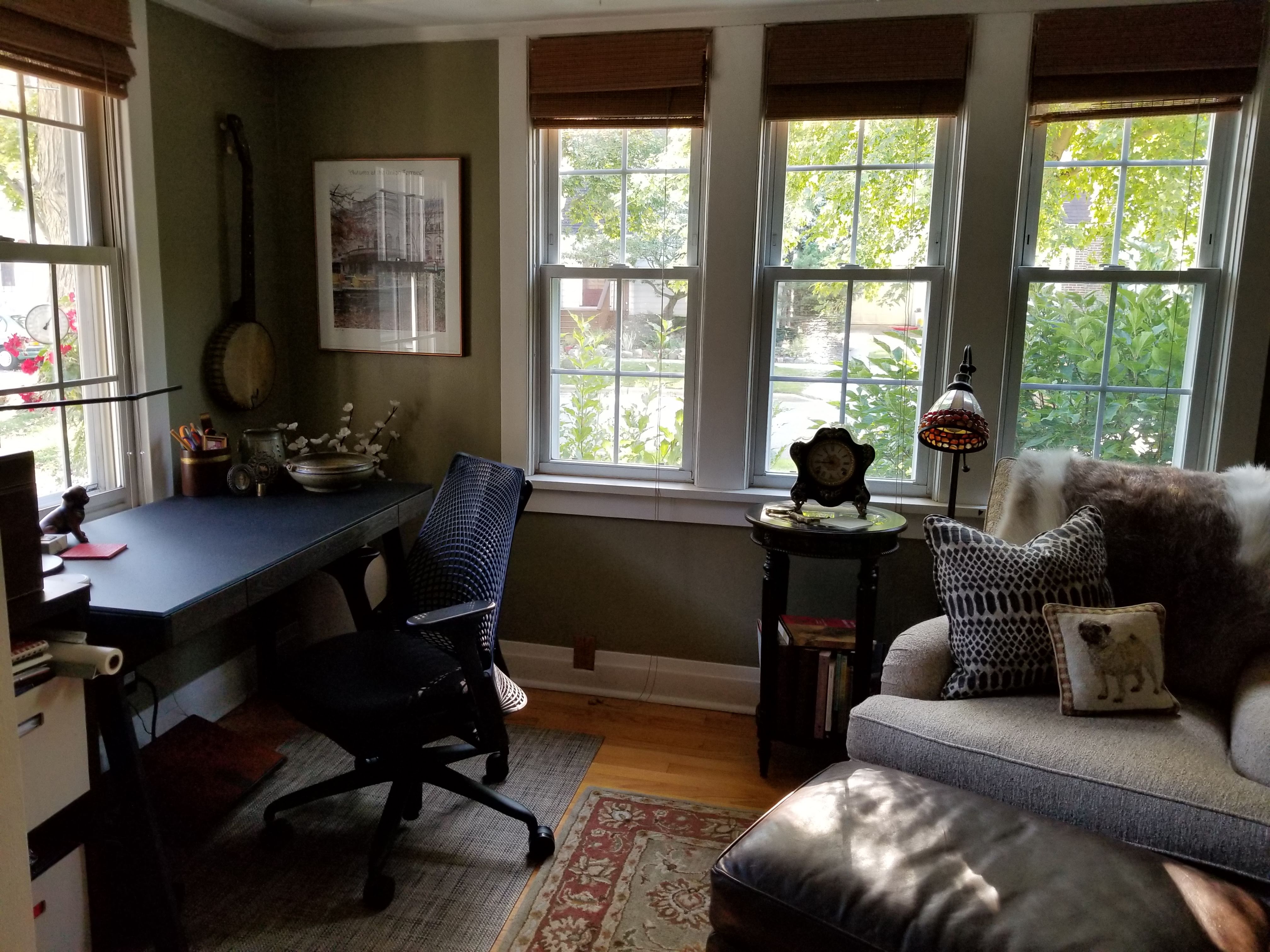
This week I will have my new Herman Miller office chair delivered and I couldn’t be happier. Establishing my new full-time office has necessitated measures to address ergonomics in my workplace. If you sit for a good part of your day and you are experiencing ‘unexplained’ back pain and/or neck and wrist pain, you should assess your ergonomics too.
As defined by Miriam-Webster, ergonomics is “an applied science concerned with designing and arranging things people use so that the people and things interact most efficiently and safely…” I have assisted clients in making choices that support better health and safety in the workplace. Mayo Clinic offers a nice visual guide to get you thinking about ergonomics: https://www.mayoclinic.org/healthy-lifestyle/adult-health/in-depth/office-ergonomics/art-20046169
Despite my working knowledge of ergonomics, I still underestimated the impact of changing the physical variables in my work situation while waiting for my new setup. It’s not necessarily true you feel uncomfortable while you’re working. I began getting concerned when I noticed any resting position is made more uncomfortable by the amount of time I work in a situation with poor ergonomics. I can’t wait to write my next entry from the new spot. I will definitely have something more inspirational to write about and I’ll be sure to include a photo!
It was so energizing to be part of the rally that took place at the Capitol last week as part of the Climate Strike. It also gives me pause to again reflect on this question: Is it possible to be an interior designer while also challenging an ethos of consumption?
I believe so! Along with my interior design degree I earned a certificate in sustainable business. I wanted to employ a business strategy that was in alignment with my desire to support a beautiful and sustainable future. It was a very conscious decision to center my business around helping clients make outstanding design choices, not selling them products. That’s just one small effort to try to stem the tide of mass consumption that is destroying our environment.
To be sure, I don’t want my clients to feel bad about making purchases in their pursuit of a more whole and happy life. We all do it! However, I do want to encourage all of us to be thoughtful when making those decisions.
What are some things I can help you to consider when making purchases? There are a few ideas that come to mind right away. For example, I will help you determine whether a purchase will actually advance your design objectives. I’m not looking to make a sale in order to keep my business, so you will get a fully impartial and truthful answer to this question. How refreshing!
Next, and very importantly I will help you avoid the temptation of buying cheap crap, or expensive crap for that matter (and there is both). These are items that will neither outlive their usefulness to you nor can they be recycled or passed on for someone else to reuse. Furthermore, even a quality item that costs considerably less than you would expect probably should be looked at more closely for the environmental impacts of the manufacturing process. This is just one area of suspicion when a deal seems too good to be true. I can help you research and identify products and vendors that are more holistically successful in addressing their environmental impacts.
Finally, I am happy to help you find options among all manner of sources for gently-used items, including those thrifty and garage sale finds. That’s fun stuff – and since I ran out of room for anything else I’m more than happy to help you out!
One might be curious why I chose to include in my tagline ‘for purposeful people.’ There are a lot of good reasons for this decision but it first came to me as a complete intuition and I trust it. First and foremost, I pursued interior design as an extension of my own desire to be purposeful in what I do. I believe we all desire to be purposeful so I expect to find common ground with anyone who wishes to work with me!
It’s been a long journey for me to embrace interior design as my purpose. For many years I was guilty of failing to associate interior design with purpose. That seems so unfair even as I write this. Few factors have been as influential as my surroundings in staying balanced, focused and refreshed in all of my other pursuits in life. How could something so fundamental to my existence remain so illusive to me as a cause to pursue? I hesitated to get my interior design degree in spite of my lifelong love of design and the intense value I consistently placed on my environment.
I think the ‘why’ in my hesitation is probably something that sounds familiar to a lot of us do-good, save-the-world types. To put it bluntly, we stereotype interior design as the folly of privileged people. The idea of embracing privilege as the construct that makes our work possible doesn’t sit well with us. Our rural Midwestern egalitarian values generate a natural resistance to anything we associate with being too ‘vain’ or ‘showy.’ As a feminist, I was worried that my obsession with interiors would too quickly align me with a certain set of beliefs about assigning women their ‘place’ and that didn’t sit well with me either.
I have spent a lot of years unpacking that last paragraph in order to get my degree and become an interior designer. It’s my first love, and like all first love it is innocent and pure. It’s what makes me happy and what lifts me up so I can spread happy. We can’t spread happy if we’re not happy. If it weren’t for the special places I happily created that gave me peace and joy in a turbulent world, I would have lost my drive to be of service at all. EVERYONE needs these places that keep their batteries charged for doing all manner of good things. I am privileged to get on my soapbox and advocate for all of us. Good design can help you on your journey!
“You should ask yourself with every decision you make: Is this good for the company?” Quote from the classic film Office Space.
This is how I knew that a career as a commercial interior designer was likely to stagnate….I love the challenge of designing commercial office spaces and managing complex projects. I was told I was good at it. Possessing a humanist perspective and choosing an evidence-based practice however, I have no love for open office designs.
I haven’t had a conversation with a single interior designer who openly agrees with me on this feeling toward open office designs. I think that is unfortunate because perhaps it is a disservice to clients who mistakenly think this kind of design is a panacea for workplace camaraderie and productivity. The scientific evidence that survives academic peer review simply doesn’t support this conclusion.
Organizational psychologist and Stanford Professor Bob Sutton notes that despite the overwhelming evidence that open office designs are problematic, “Many administrators and building designers seem to have a hard time ‘hearing’ such evidence and keep pushing for open office designs – they prefer to talk about selected anecdotes instead.” Notes blogger and highly successful software developer Joel Spolsky: “Office space seems to be the one thing that nobody can get right and nobody can do anything about...Hey, this is my job; this is where I spend my days; it’s my time away from my friends and family. It better be nice.”
There are compelling reasons to consider open office designs such as cost and in some specific instances they indeed can be beneficial for other reasons that are good for companies. One interesting theory identifies specific benefits of open office design for the millennial workforce. A recent article quoted office design expert Jonathan Webb of KI Furniture as saying “millennials value community and collaboration, just as they did in college. We know that newly hired graduates’ top desires are the latest and greatest technology and a sense of community and collaboration.”
As a former educator who worked primarily with college -age millennials, I have a different idea about that. A lot of people — especially millennials — have extreme difficulty with the prospect of failure for a variety of sociological reasons. The social utility that open office designs offer is the opportunity to avoid the anxiety that comes with taking decisive actions. Decisive actions typically result in specific outcomes that can succeed or fail in ways that are beyond your control. That prospect of failure is untenable for a lot of people, especially millennials. Open office systems offer a compelling alternative to decisive action: create a lot of motion around your job and tout that activity as a successful outcome. Another option: when something doesn’t meet expectations, there is a bevy of collaborators onto whom one can shift blame. This may cure anxiety about failure in the short run but it destroys morale in the long run. Is this good for your company?
On a separate note, there is growing interest and research into one segment of the population that is deeply harmed by open office designs. HSPs or “Highly Sensitive Persons” represent about 15-20% of the population and have particularly sensitive nervous systems. They tend to process everything around them very deeply and are easily overstimulated. For these folks, open offices are a nightmare. And guess what, they are some of the most brilliant creative minds available – specifically because they are highly sensitive. All things being equal to those persons in weighing competing offers, an open office design will lose every time to a private office. Is this good for your company?
How do we bring Kindness, Beauty and Truth to our work? This can be a challenge in a world that demands so much fleeting engagement and offers so few opportunities to develop our authentic selves. As a shorthand approach, it can be tempting to substitute pleasantry for kindness, attractiveness for beauty and personal honesty for truth. It’s great to be nice, attractive and honest; it’s just incomplete.
Pleasant, attractive and honest are temporal qualities whereas kindness, beauty and truth are enduring qualities. Though they may seem the same up front, the latter qualities take considerably more time, energy and investment to develop.
For example, we may value pleasantry but defining what is pleasant or prescribing pleasing behavior is to dive into an instant quagmire of social norms and subjectivity. We can consider someone unpleasant and therefore unkind when they don’t meet our personal or cultural criteria for what constitutes pleasantry. We can assume someone is kind who is simply being pleasant in order to gain something from us. Kindness is a virtue not so easily defined and therefore it is not easily withdrawn or undone. We trust and value kindness because it is a more permanent state of mind that can only be revealed over time.
Getting to my point about your design, it’s fairly easy to parse out the differences between what is temporal and enduring over time in design. Something you found attractive at one point can cease to be beautiful in your mind shortly thereafter. A lot of external factors shape our attraction to particular design elements. You can also find that although your design is honestly beautiful in one sense, it doesn’t reflect the truth of who you are and how you live your life. Neither of these scenarios seem worth the time, energy or investment you put into developing your design.
In finding your designer, making meaningful distinctions is more difficult. You may ask, does all this matter really? That is something only you can answer. I have found repeatedly that design cannot reflect something that does not exist within the designer (s) and the design process. If you want to create something with an enduring impact, both designer and process should be considered with that goal in mind.
“The ideals which have lighted my way, and time after time have given me new courage to face life cheerfully, have been Kindness, Beauty and Truth” – Albert Einstein
It is my belief that all of us are creators; all of us apply a design methodology to some aspect of our life quite intentionally but don’t necessarily think of it as such. Our most innate drive as humans is to seek happiness and fulfillment. I believe that our minds and bodies need kindness, beauty and truth for fulfillment in much the same way they need clean air, water and good nutrition to survive. Design represents the means we develop to move from simply surviving to thriving.
What makes some of us Designers as professionals is our ability to hone, adapt and scale the methods that we all intuitively know and use to achieve individual fulfillment. If we employ kindness, beauty and truth in our pursuit, we can help unleash the potential in every person to create something. And when we all engage in creating something; there is the potential to create something amazing together.
Welcome to my inaugural blog post! I intend to deliver substantive reflection on design and this post is no exception. First and foremost, the purpose of design should be to foster enjoyment of life! It’s a serious quest as my pug Stanley will attest. The custom cushion I had made for him allows him to enjoy the thrill of his bike ride despite his arthritis. Nothing gets bigger smiles from onlookers and the cheerful “Stanley!” calls make us both smile ear to ear. Those precious joyful moments are the stuff of life. This very simple design solution has an exponential impact. Design doesn’t have to be elaborate to be effective. Whatever type of design lets you experience joy and share it with others, I hope I can be part of that in some way.