Whenever I am observing things that seem paradoxical in the ways people think, I can usually find a concept or an idea in the work of Carl Jung that is helpful. I don’t claim to be a scholar of Jung. I might not even have a firm grasp of what I’m writing about. However I keep bumping into him at meaningful moments and maybe you might find this interesting too.
One of those interesting concepts is that of a Jungian archetype, that I will describe as manifestations of the sum total of our human experiences. They are concepts and forces more than actual “things” but they play a powerful role in how we understand ourselves and relate to our environments. They’re categorized as Persona, the Anima or Animus, The Self, and the Shadow. There are lots of archetypes within those categories, like “trickster,” “demon”, “mother,” or “god.”
The work of writer Joseph Campbell was heavily influenced by Carl Jung, writing most notably about the power of mythology and the hero’s journey in literature. You can draw though-lines to the work of Jung and Campbell when reading or watching some of your favorite stories, the one’s that captivate our furthest imagination and yet seem so relatable at the same time.
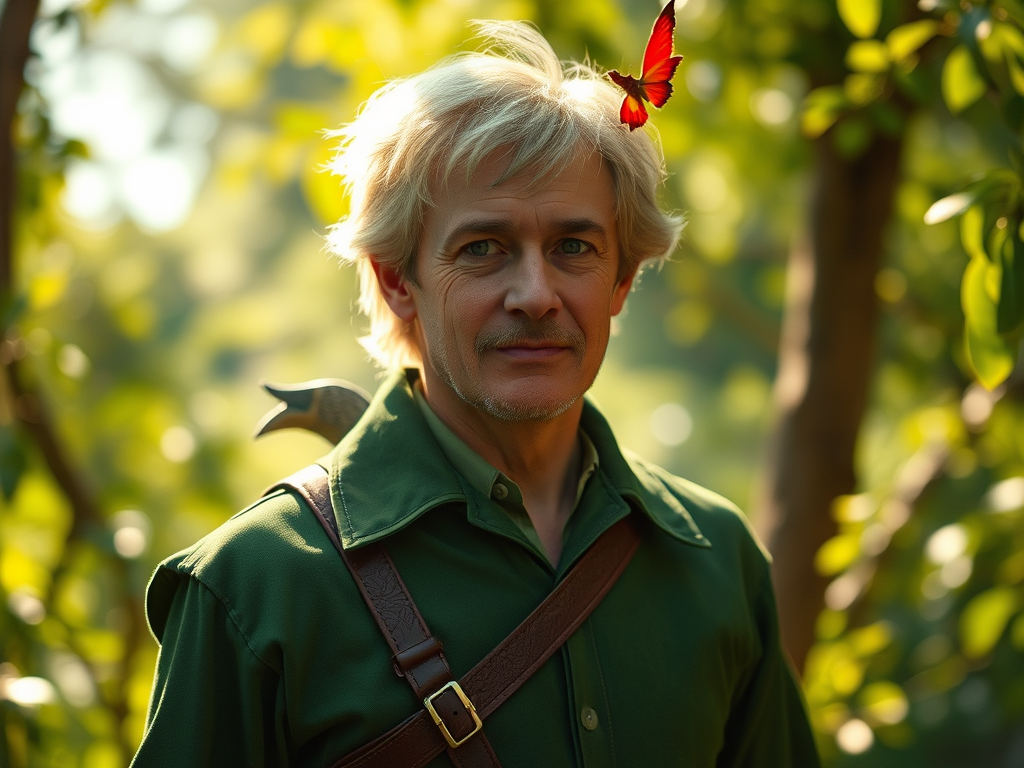
One particular archetype and manifestation of Jung’s work can be found in the story of Peter Pan, the name (and main character) of a story about a young boy who never grows up. Jung’s name for this type of character was the archetype Puer Aeturnus (also a feminine Puella Aeturna). The hero of the story, Peter Pan, is beloved for his imagination, his carefree nature and his youthful optimism.
Few children grew up without some adoration of Peter Pan. Yet in our contemporary culture we also see the potential downside to someone refusing to grow up, such as an unwillingness to accept responsibility or lack of ability to deal with adult-scale challenges in an effective way. There’s even a “Peter Pan Syndrome” used to describe individuals whose life struggles are sourced from a stubborn refusal to grow up.
According to Jung, we all possess an inner puer aeternus or puella aeterna. The influence of these archetypes can lurk in the shadow of our subconscious. We may not be aware of the ways in which this archetype operates when we construct the world to make sense to us. Perhaps in the way we respond to conflict or perhaps in our ability to relate to young people we can better observe our interactions with this archetype. It’s not necessarily a good or bad thing; according to Jung it just is.
We also possess an inner nemesis to this archetype, called the “Senex,” or the old man. I could probably go on for a bit about the significance of a lack of feminine equivalent here, but I’ll stay on topic for the sake of brevity. In the Peter Pan story, the senex is vilified as Captain Hook. Captain Hook represents aging as a corrupt and evil force in the world. Interestingly, the word senex is the Latin source of the term Senator among other things. And perhaps among actual Senators we can see the full range of manifestations for the senex archetype. From being a source of wisdom and legitimate authority, to possessing an ambition to control others; we can see how the senex can operate within our subconscious in different ways.
So when (former Senator) Joe Biden expressed that we were in a ‘battle for the soul of our nation,’ I think he was on to something. I think Jung provides an explanation for what is happening and why so many people can be so polarized; further categorizing one side as “good” and the other side “evil.”
The satisfactory explanation for such deep polarization among many pundits is that people aren’t getting their information from the same place. The news silos and social media are conditioning people to perceive one another the way they do. While I do think that contributes, I think the deeper issue involves the puer/puella and the senex in all of us. Our world is one that requires serious adulting, and that is growing increasingly unpleasant. The most advantageous skills (mastering technology) for successful adulting are possessed principally by young people. As a result, the way we perceive conflict, the way we view problems, the way we attempt to solve them–all of that discourse is being driven by relatively young people.
The most effective tools for human survival are amassed among those least able/willing to use them to fix problems. It doesn’t make anyone good or bad, it just is.
Ok, Boomer. (ps. I happen to be Gen X but you probably understand why I wrote that).
So who ends up in the race for President? The two oldest men to run for office. Why? Because our entire collective unconscious is dominated by the puer and puella. And the senex is what we’re all seeking to balance it all out. But because the puer/puella are producing the show and the senex doesn’t have a fan base, our candidate choices were manifested in two very different takes on the same archetype. In one you might see necessary command and control and in the other you might see silly naivete. In one you might see a stubborn refusal to grow up and deal with real problems and in one you might see an old man rendered incompetent by his ineptitude. In any case, it seems people were initially seeking candidates they thought might possess what’s needed to meet the challenge of very adult-scale problems. And that’s not the puer/puella, as much as we might like them.
The presidential race has changed. Many were surprised and wondered what sparked so much enthusiasm for the new democratic ticket. Simple, we have what’s relatable and popular about the puer/puella combined with something approaching the wisdom of the senex. It’s the formula that worked for the Obama – Biden ticket and also the Biden – Harris ticket. And it even worked for Trump – Pence too, except with Trump cast as Peter Pan and Pence as the senex.
I think we’re all painfully aware this isn’t Never Never Land. Paradoxically, Trump is the likely the first person to tell you that. He’s promising to “restore” the American version of Never Never Land, even though it never existed. There’s a reason it’s called “Never Never.” Maybe some daydreams need to stay just that. We’ve got real work to do.
 Sara L. Hinkel, M.S.Ed.