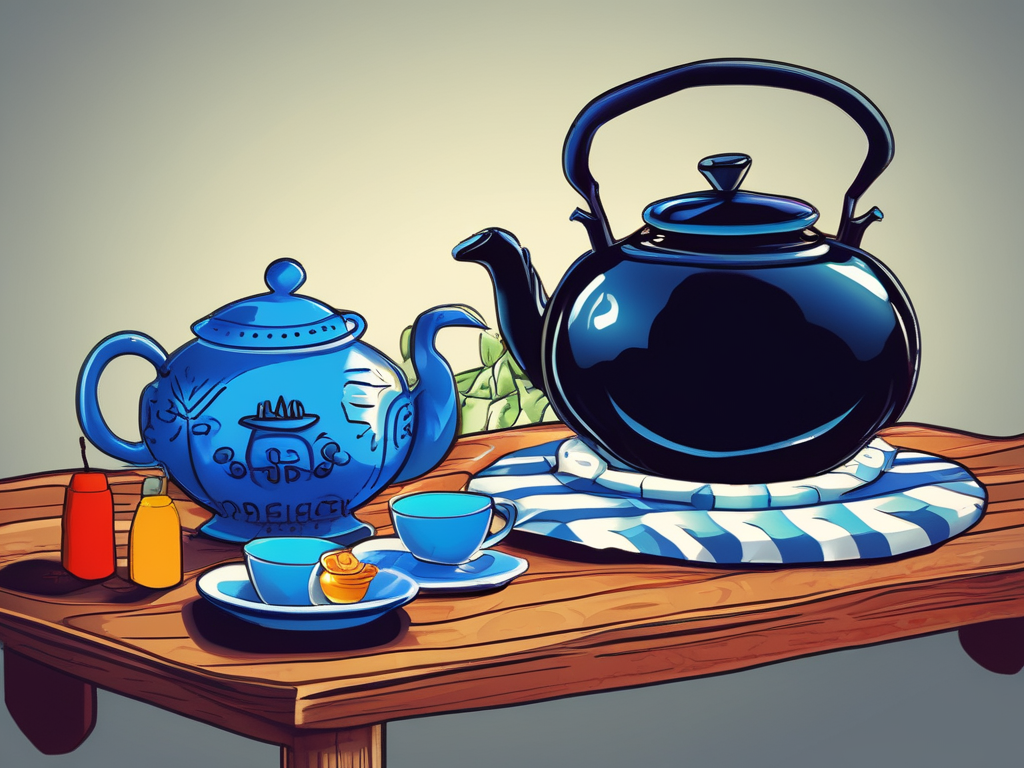
“…not all people are aware of the difference between a tea kettle and a teapot… Sure, it’s easy enough to confuse them. They both look sort of similar with a spout and a lid. They both have names which include the word tea. And they both contain hot water at some point in the tea-making process. Confusing the two, however, can have dire consequences for yourself, your tea, and especially your teapot.
There is much to reflect upon these days in our politics. Our nation seems deeply polarized and from the perspective of our politicians, a bright line exists between our political parties and therefore our choices on the ballot. And yet, when it comes to the things we see and tend to dislike about politics and politicians generally, we’re having a lot of conversations as though our choices remain largely indistinguishable from one another.
I simply don’t agree with that assessment. I don’t think it’s difficult to see the differences in tone and method, regardless of how you feel about them. So why aren’t those profound differences fueling our discourse? I did a bit of searching for a term that seems to apply here: anchoring bias. This cognitive bias occurs when we find something to refer our decisions and/or reasoning back to—the anchor. The anchor is usually the first piece of information we receive, as it forms our understanding of the topic. Depending on what that is, this can become challenging if the initial anchor isn’t the best or most relevant option, as it can throw user research off course.
So let’s say we’ve become attached to a certain set of messages aligning with one political party or politician at an early age. Perhaps through our family of origin, our church or other affinity groups. Those can serve as an important and frequently reinforced anchor in our lives. When that happens to us as children, we often don’t reflect on the substance underlying those anchors. We simply know of their existence and enjoy a sense of connection within a community that affirms the existence of those anchors and celebrates them. This can give rise to yet another bias: social desirability bias. Social desirability bias is heavily influenced by societal and cultural norms and expectations. We resist information and situations that may challenge the relevance or importance of our anchors.
It’s easy to see how a potent formative experience can bias our future assessments of many things including (and most relevant to this post) the political landscape. We refuse to take in new information that suggests our anchor may no longer be the best option, and one powerful motivation is the desire to preserve a socially desirable alignment with the source of our anchor.
There was a time in this country where the anchor for most people would have been the ideals of democracy. I can say that with some degree of confidence when I think about my parents, whose formative experiences took place during and immediately following World War II. That anchor is unwavering for many and continues to be to this day. Generations became familiar with the mechanics of democracy from an early age. My parent’s generation and even my generation, spent a great deal of time learning about how democracy works. Civics instruction was required and when I was a kid, I couldn’t turn on the television without Schoolhouse Rock belting out how a bill becomes a law.
What we didn’t learn enough about was the important connection and, at times, significant gap that exists between the values, mechanics and outcomes of our democracy. Most of us weren’t exposed to information about how that gap explains where we fall short of our ideals. We hear both political parties today talking about the other being a threat to our democracy. It’s very potent emotional language for most people readily observing our shortcomings, but the substance of those arguments needs to be explored more deeply. In the deep sea of our politics, media and our rhetoric there is great commotion and emotion. We can start to feel out of control. Dragging anchor is defined as the loss of the holding power of the anchor system. If this loss is sudden, it may require an immediate reaction to retain control over the ship. Once the anchor starts dragging, the change in the ship’s position may occur quite rapidly, especially in adverse weather and current.
If the ideals of democracy are seen to be the anchor we’re dragging (because we fall short of them constantly), then immediate action would seem necessary. But what is the necessary immediate action? Abandon all of the values, twist all of the methods and dismiss the positive outcomes we have achieved? What if the anchor is actually our formative experiences and social relationships? Those are powerful and important but they can sometimes limit our imagination and create a sense of urgency when their significance is threatened, to be sure. What if the ship in peril is carrying the substance (values, methods and outcomes) of democracy itself? Because that does seem to be the case. If we can shed our biases, does it become more clear whose alignment and goals for desirability rest among those who wish it to sink?
 Sara L. Hinkel, M.S.Ed.