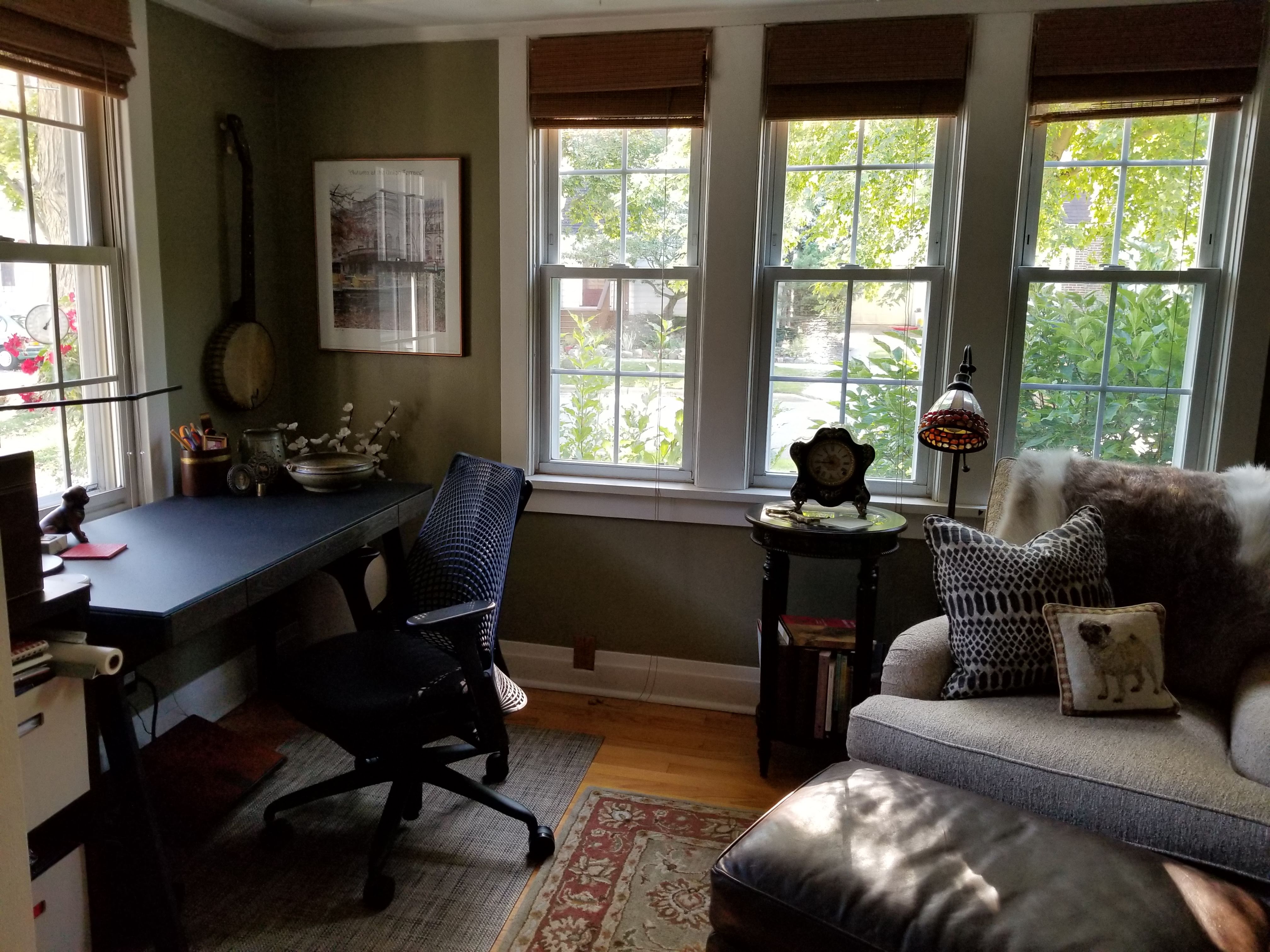
After 
Before
Aspirational brand strategy may appeal to a person’s psychological, social and/or economic aspirations, rather than their psychological, social and/or economic realities. Aspirational brand strategy positions a product or service through image, appealing to what they want to be. https://www.tnp.no/norway/global/3059-whats-with-all-the-hype-a-look-at-aspirational-marketing
Interior design is just loaded with aspirational brand strategy. It’s not necessarily a bad thing. After all, at its core design is aspirational in nature, as I’ve been attempting to describe all along. We design our spaces and experiences to elicit satisfaction with, ultimately, ourselves. Whatever we feel is missing in our life becomes the focus of our design aspiration. Creating something of beauty can mean a lot of different things to both creator and observer. It can simultaneously motivate us to create and make us vulnerable to other people’s ideas about our creation.
I mentioned my office redo last week and excitement about my Herman Miller chair. Herman Miller is both an aspirational brand (prized for the status it conveys) as well as being a darn good product. My concern is with the latter but people do care about what their design says about them generally, including their status. I do feel good saying I could purchase a real Herman Miller chair and not a knockoff of the design. I know my money went toward supporting designers at these companies willing to invest in good quality design – an absolute necessity for all manner of design to remain relevant and aspirational.
Prior to today’s proliferation of the internet, it would be more difficult for a brand to be aspirational without also delivering on quality. There were few means to convince people they needed to purchase something for any reason other than the quality of its design and construction. The higher cost of quality products made them more exclusive to people who could afford them; thus making them aspirational to most people.
Today, it’s much easier to make money tapping into all manner of aspiration. In a way, this expansion of what consitutes aspiration is liberating individual expression and association. In many ways that makes interior design relevant to more people (think HGTV, tiny homes, vintage chic etc). It also opens up a door for companies to gain customers with clever branding while also compromising on quality for higher profits. It makes sense we should therefore see an explosion in online consumer reviews and competition for primacy among companies on the internet. We haven’t quite figured out that efforts to achieve primacy online still seem to employ more game theory involving consumers than anything else that is good for consumers.
And this is why you probably won’t see me on Facebook. I just don’t think I can do it. I don’t judge people who do use it, but if I wasn’t willing to do it personally I don’t feel as if I can do it for my business without compromising the honor of my intentions online. Several have said I’m nuts. We’ll see… I do want people to get to know me. Is there another way? Coffee perhaps?
 Sara L. Hinkel, M.S.Ed.