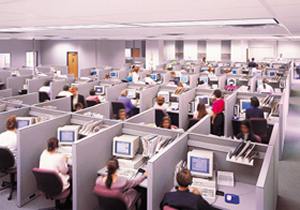
This is how I knew that a career as a commercial interior designer was likely to stagnate….I love the challenge of designing commercial office spaces and managing complex projects. I was told I was good at it. Possessing a humanist perspective and choosing an evidence-based practice however, I have no love for open office designs.
I haven’t had a conversation with a single interior designer who openly agrees with me on this feeling toward open office designs. I think that is unfortunate because perhaps it is a disservice to clients who mistakenly think this kind of design is a panacea for workplace camaraderie and productivity. The scientific evidence that survives academic peer review simply doesn’t support this conclusion.
Organizational psychologist and Stanford Professor Bob Sutton notes that despite the overwhelming evidence that open office designs are problematic, “Many administrators and building designers seem to have a hard time ‘hearing’ such evidence and keep pushing for open office designs – they prefer to talk about selected anecdotes instead.” Notes blogger and highly successful software developer Joel Spolsky: “Office space seems to be the one thing that nobody can get right and nobody can do anything about...Hey, this is my job; this is where I spend my days; it’s my time away from my friends and family. It better be nice.”
There are compelling reasons to consider open office designs such as cost and in some specific instances they indeed can be beneficial for other reasons that are good for companies. One interesting theory identifies specific benefits of open office design for the millennial workforce. A recent article quoted office design expert Jonathan Webb of KI Furniture as saying “millennials value community and collaboration, just as they did in college. We know that newly hired graduates’ top desires are the latest and greatest technology and a sense of community and collaboration.”
As a former educator who worked primarily with college -age millennials, I have a different idea about that. A lot of people — especially millennials — have extreme difficulty with the prospect of failure for a variety of sociological reasons. The social utility that open office designs offer is the opportunity to avoid the anxiety that comes with taking decisive actions. Decisive actions typically result in specific outcomes that can succeed or fail in ways that are beyond your control. That prospect of failure is untenable for a lot of people, especially millennials. Open office systems offer a compelling alternative to decisive action: create a lot of motion around your job and tout that activity as a successful outcome. Another option: when something doesn’t meet expectations, there is a bevy of collaborators onto whom one can shift blame. This may cure anxiety about failure in the short run but it destroys morale in the long run. Is this good for your company?
On a separate note, there is growing interest and research into one segment of the population that is deeply harmed by open office designs. HSPs or “Highly Sensitive Persons” represent about 15-20% of the population and have particularly sensitive nervous systems. They tend to process everything around them very deeply and are easily overstimulated. For these folks, open offices are a nightmare. And guess what, they are some of the most brilliant creative minds available – specifically because they are highly sensitive. All things being equal to those persons in weighing competing offers, an open office design will lose every time to a private office. Is this good for your company?
 Sara L. Hinkel, M.S.Ed.